

It can feel confusing when tests are mentioned in women’s health, especially when you are not sure why a blood test, ultrasound, or screening may be advised. You may recognise the name of the test, but still not know what it is meant to check or what the result may help clarify.
That uncertainty can make the next step feel harder than it needs to be, particularly when different concerns can lead to different types of tests. If you are already exploring care through a women’s clinic in Singapore, understanding the purpose of testing can make the process feel clearer.
In this article, you will learn why certain tests may be recommended, what blood tests, ultrasound, and screening are used for, and how results may help guide the next step in care.
Why Tests May Be Recommended in Women’s Health
Women’s health tests are usually recommended for a reason. They are used when a doctor needs a clearer picture of what may be causing a change, symptom, or concern, rather than simply ordering more tests.
In some cases, a test may help confirm whether a suspected cause is likely. In others, it may help rule out certain possibilities, assess how your body is functioning, or show whether there are changes that need closer review. This is why the same concern does not always lead to the same test for every person.
The type of test usually depends on the question that needs to be answered. A blood test may help assess internal factors such as hormone levels, iron status, or thyroid function. An ultrasound may help look at structures such as the uterus or ovaries. A screening test may be used to look for early changes before they become more serious.
This also explains why tests are part of decision-making, not the final answer on their own. The result helps guide the next step, whether that means reassurance, monitoring, treatment, or further assessment.
Doctor’s Insights: Tests are usually performed to provide better clarity based on your individual condition so the doctor can recommend the most appropriate treatment for you. The focus is on investigations that will genuinely help clarify your situation and guide the next step.
– Dr Michelle Chia, Ezra Clinic
Blood Tests in Women’s Health: What They May Help Assess
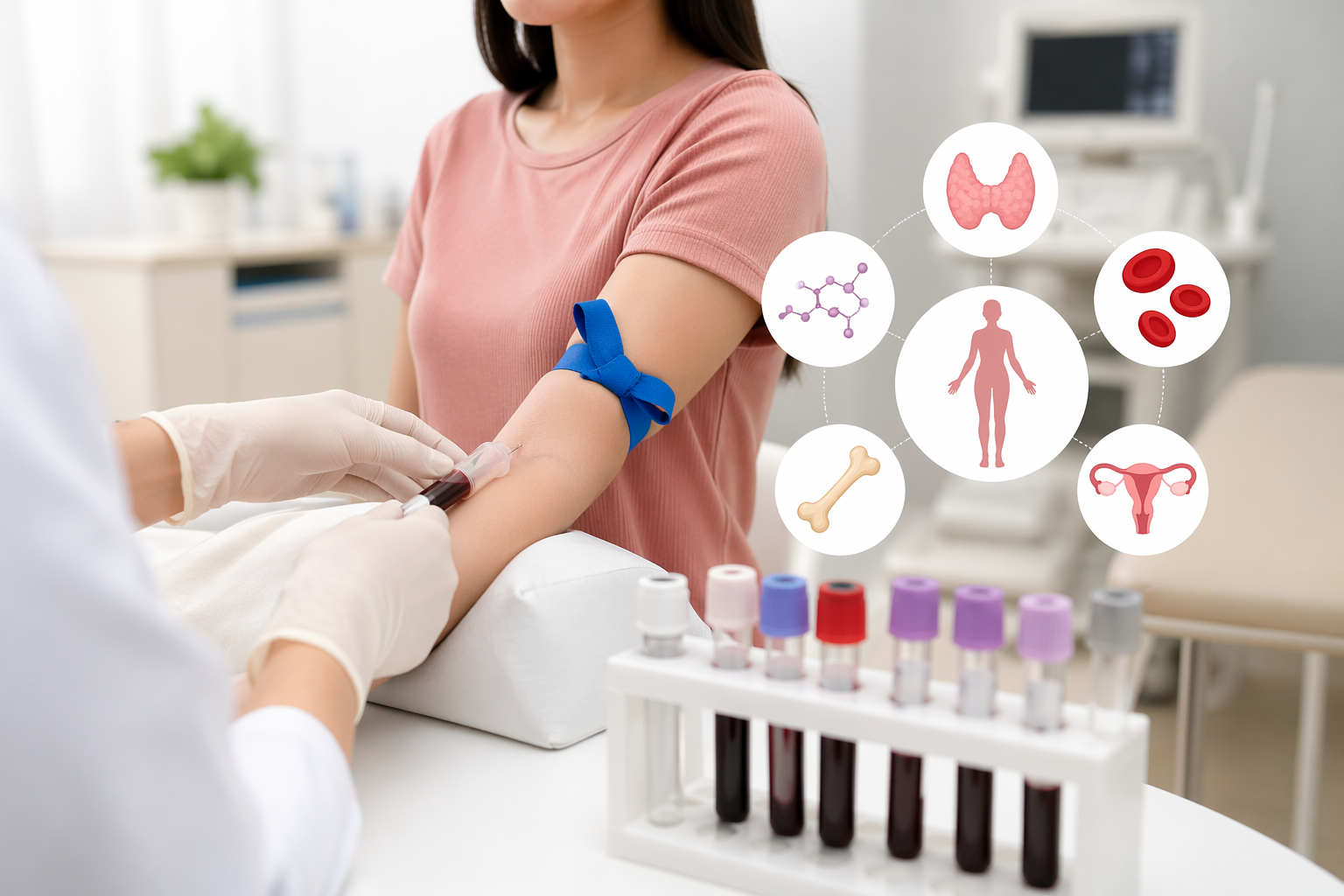
Blood tests are often used when a doctor needs more information about what may be happening inside the body. They may help assess hormone patterns, general health factors, pregnancy-related questions, or other findings that cannot be confirmed through symptoms or examination alone.
The tests chosen usually depend on the concern being reviewed. In some cases, blood tests may help assess hormone-related patterns linked to irregular periods, ovulation changes, fertility questions, or other shifts that suggest the body may need a closer look. In other cases, they may be used to check broader health factors such as iron levels, thyroid function, or blood sugar, especially when the concern may not be limited to the reproductive organs alone.
Blood tests may also be used when pregnancy-related questions need clarification or when a doctor is reviewing how a known issue is changing over time. Even then, they are usually not interpreted on their own. The result is often most useful when read alongside your age, cycle pattern, symptoms, medical history, and any other findings already available.
Ultrasound in Women’s Health: What It May Be Used For

Ultrasound is often used when a doctor needs to look more closely at structures inside the pelvis. Unlike a blood test, which helps assess what may be happening through a sample, an ultrasound helps show what the uterus, ovaries, and surrounding areas look like.
This may be helpful when symptoms or examination findings suggest that a structural cause needs to be considered. For example, a pelvic ultrasound may be used when there are questions about abnormal bleeding, pelvic pain, fibroids, ovarian cysts, or other concerns involving the reproductive organs. It may also help review the uterus, ovaries, or endometrial lining more clearly.
Ultrasound can help show whether there are visible changes that may explain the concern, whether the pelvic organs appear normal, or whether there are findings that need follow-up. It is also common for ultrasound and blood tests to be used together when a doctor needs to understand both how the body is functioning and whether there are structural changes in the pelvis. Read in context, these tests can help give a fuller picture and guide the next step more clearly.
Screening in Women’s Health: How It Differs From Diagnostic Testing
Screening and diagnostic testing are not the same, even though both are important in women’s health. Screening is usually used to look for early changes or possible concerns before they cause obvious symptoms, while diagnostic testing is used to investigate a specific issue that already needs closer assessment.
This difference matters because not every test is done for the same reason. A screening test is generally about early detection, not about explaining one symptom straight away. In women’s health, screening may help identify whether closer review, repeat testing, or follow-up may be needed, even when you feel well and have no clear concern at the time. If you want to understand when routine review may come into the picture, you can read more about women’s health check-ups.
A screening result does not always mean there is a serious problem. In many cases, it simply shows that something needs a closer look or a more specific form of assessment. That is an important part of how screening works, because it helps identify who may need more review without relying on symptoms alone.
Doctor’s Insights: Screening is usually preventive in nature, while diagnostic tests are performed when a patient presents with abnormal symptoms. Screening tests are not designed to diagnose a condition immediately but to identify when closer assessment may be needed, even before symptoms appear.
– Dr Michelle Chia, Ezra Clinic
Tests That May Be Used for Different Women’s Health Concerns

The tests used in women’s health usually depend on the concern being reviewed. If you are still trying to understand whether a change or discomfort may need attention, you can also read more about women’s health symptoms. Once assessment begins, the next step depends on what the doctor is trying to clarify.
This is why one person may be advised to have a blood test, while another may need an ultrasound, a screening test, or a more focused laboratory test. The choice depends on what needs to be assessed, confirmed, or ruled out.
Irregular Periods or Cycle Changes
When periods become irregular, unusually heavy, delayed, or different from your usual pattern, testing may be used to understand whether the change is more likely to be hormonal, structural, or linked to a wider health factor. Blood tests may help assess hormone-related patterns, while ultrasound may sometimes be used if the uterus or ovaries also need to be reviewed.
Pelvic Pain or Abnormal Bleeding
Pelvic pain or abnormal bleeding may lead to testing when a doctor needs to assess whether there could be a structural cause, a hormonal issue, or another underlying factor that needs closer review. Ultrasound is often useful here because it may help assess the uterus, ovaries, or pelvic area more directly, while blood tests may sometimes provide wider clinical context.
Fertility-Related Concerns
When the concern relates to fertility, testing may be used to assess factors such as ovulation-related patterns, hormone levels, ovarian activity, or whether ultrasound findings suggest anything that may affect the next step in assessment. The exact tests depend on the question being explored, not simply on the fact that pregnancy has not happened yet.
Vaginal, Cervical, or Infection-Related Concerns
Some concerns may call for more focused testing, especially when the question relates to vaginal symptoms, cervical changes, or a possible infection. In these situations, the test may involve a swab, laboratory testing, screening-related assessment, or another targeted approach based on what needs to be clarified.
Menopause-Related or Hormonal Transition Concerns
During menopause or other hormonal transitions, testing is not always needed in every case. However, it may sometimes be advised when symptoms, age, bleeding patterns, or the overall clinical picture make further clarification helpful, especially if changes should not be assumed to be part of the transition alone.
What Test Results May Help Clarify
Test results are useful because they help make the picture clearer. They may support what the doctor already suspects, show that some causes are less likely, or indicate whether more review may still be needed before the next step is decided.
This matters because a result is not always about finding one final answer straight away. In many cases, its value lies in helping narrow the possibilities and guide care more accurately. A result may help confirm a likely cause, rule out other possibilities, or show that follow-up, repeat testing, or another type of assessment may still be needed.
Even then, the result is usually not read on its own. It is interpreted alongside your symptoms, medical history, examination findings, and the wider clinical picture, because the same result can mean different things depending on the context.
What Happens After Testing
What happens after testing depends on why the test was done and what the result shows. In some cases, the findings may be reassuring. In others, they may help guide treatment, monitoring, or a more focused next step.
This is why testing is usually part of a wider process rather than the end of it. The result helps shape what happens next, but it is still interpreted alongside your symptoms, medical history, and overall assessment. If you want to understand how these discussions are usually approached in more detail, you can read more about a women’s health consultation.
A reassuring result may mean no immediate action is needed, while other results may point towards follow-up, repeat testing, monitoring, or a more targeted plan. Not every concern is clarified in one step, and that does not always mean something serious has been found. In many cases, it simply means the next decision is being guided by a fuller and more accurate picture.
Doctor’s Insights: Not every result leads to treatment. In many cases, tests are performed mainly to rule out serious causes and provide better clarity about the condition. Sometimes, the most appropriate next step may be careful monitoring rather than immediate treatment.
– Dr Michelle Chia, Ezra Clinic
Understanding the Role of Testing in Women’s Health Care
Testing plays an important role in women’s health because it helps move care from uncertainty towards clearer decision-making. A blood test, ultrasound, or screening test is usually recommended to answer a specific question, not simply to add another step.
That is why tests are best understood as part of the wider clinical picture. They may help confirm a likely cause, rule out other possibilities, or show whether monitoring, treatment, or further review may be needed. On their own, they do not tell the full story, but they often help make the next step more informed.
If you are trying to understand which tests may be relevant to your concern and how they fit into the next step in care, you can learn more through a women’s clinic.
References:
- National Health Service. Blood tests.
https://www.nhs.uk/conditions/blood-tests/ - National Health Service. Ultrasound scan.
https://www.nhs.uk/conditions/ultrasound-scan/ - Centres for Disease Control and Prevention. Are You Up to Date on Your Preventive Care?
https://www.cdc.gov/chronic-disease/prevention/preventive-care.html - Singapore Ministry of Health. Screen for Life.
https://www.moh.gov.sg/